Endless Frontier 2: Idle RPG
- 3.9
- Rating
- 50.00K
- Installs
- Free
- Price

 Analysis by App-foxy
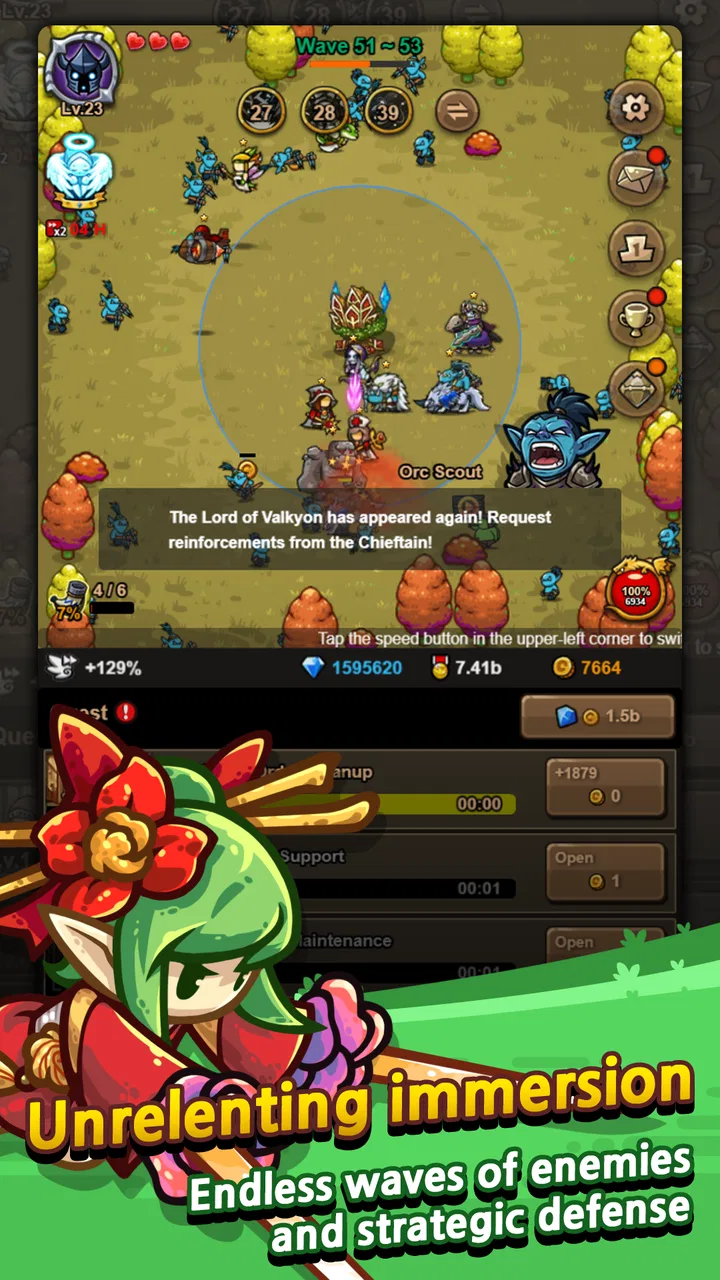
I spent time with Endless Frontier 2: Idle RPG as a light, hands-off fantasy defense game, and my first impression was clear: it is aimed at players who enjoy building a team gradually rather than controlling every second of a battle. You assemble heroes, improve their strength, and let them face continuing enemy waves while the game keeps the broader progression moving. That makes it easy to check in during spare moments, although it also means the experience can feel less active than a conventional role-playing game.
Developed by ekkorr, this is a free simulation game for Android users whose device runs at least Android 8.0. It is rated for Everyone, so the presentation is designed to be broadly accessible. The game reached release on April 19, 2026, and version 1.13.86 is the version associated with the current listing. Its audience is still relatively modest compared with the biggest mobile games, with over 50 thousand installs and an average score of 3.9 from around 800 ratings.
How the free model affects the experience
The most important thing to understand before installing it is that free access and complete value are not the same thing. You can start playing without paying, which makes it easy to test the core loop and decide whether its idle-defense rhythm suits you. There are also in-app purchases ranging from $0.99 to $99.99 per item. I would therefore approach it as a free trial that can become a spending game, not as a paid game with one clearly defined final price.
You May Also Like

 Pandora - Music & Podcasts
Pandora’s Music Is Easy to Start, but Harder to Recover
Pandora’s strength is its low-effort path from a seed to a station. Its weak spot is how much confidence it asks you to place in connection, setup, and quiet recovery.

 AccuWeather: Weather Radar
AccuWeather Review: A Quick, Clear Forecast for Everyday Decisions
For everyday plans, the best forecast is the one you can understand quickly. AccuWeather makes rain timing, radar, and local conditions easy to act on, with a few trade-offs.

 Hill Climb Racing
Why Hill Climb Racing Still Turns Crashes Into One More Run
A tiny car, a bumpy hill and one more upgrade: Hill Climb Racing keeps resurfacing because its simple chaos makes every near-miss feel personal.

 AliExpress - Shopping App
AliExpress Makes Global Shopping Feel Personal, but Shoppers Bear the Risk
AliExpress turns a global marketplace into a pocket-sized discovery engine. Its reach is useful, its shopping loop compelling, and its trade-offs easy to miss.

 Lords Mobile: Kingdom Wars
Lords Mobile Is a Kingdom-Building Routine, Not a Quick Match
A case-by-case verdict on the building, battles, device demands, and social commitments that make Lords Mobile rewarding for some players and exhausting for others.

 PDF Scanner app - TapScanner
TapScanner Makes Paperwork Easier to Capture, Check, and Share
TapScanner makes scanning with a phone feel less like a rescue operation and more like a dependable step in getting work done. Its capture tools are useful, though not flawless.
More From Our News Desk
View All News


That distinction matters because idle RPGs often encourage small improvements repeatedly. A low-cost purchase may look harmless in isolation, while several purchases can change the total value calculation. I recommend playing for a while without buying anything, learning which parts of progression actually slow you down, and then deciding whether spending improves your enjoyment or merely removes waiting. The free entry is a genuine advantage, but it should not be confused with a guaranteed inexpensive long-term experience.
I also like that the game can be evaluated on its own terms before money is involved. If you dislike watching a team handle most of the fighting automatically, no purchase will fix that fundamental mismatch. If you enjoy checking progress, making roster decisions, and returning to collect improvements, the free version gives you a practical way to see whether those habits feel satisfying.
The loop works best in short visits
My preferred way to play was in brief sessions. I would open the game when I had a few minutes, inspect how far the team had advanced, make the most useful upgrade available, and then leave it running toward the next obstacle. That structure fits a commute, a lunch break, or the few minutes before bed better than a game that demands uninterrupted attention.
The endless-wave premise gives those visits a simple purpose. There is always another point at which the team can be tested, and the defensive framing makes gradual improvement easy to understand. When a formation or upgrade lets the group survive longer, the result feels meaningful even though I was not manually directing every attack.
The trade-off is that the most interesting decisions are separated by stretches of waiting or routine progress. Players who want precise movement, timing-based attacks, or a constant stream of tactical choices may find the loop too passive. I would not choose it as my main game for an evening when I want intense interaction. It is better as a companion game that rewards regular check-ins.
Team building is the real reason to stay
The hero-team focus gives the game more personality than a simple automatic defense screen. I found myself thinking less about individual battles and more about whether the overall group was improving in a sensible direction. That is a useful mental shift: the goal is not just to win the current wave, but to create a team that can handle the next stretch without wasting resources on every tempting improvement.
A practical approach is to avoid spreading attention too thinly at the beginning. Concentrating progress around a dependable core usually makes more sense than trying to raise every available hero equally. In an idle game, a team that performs consistently while you are away is more valuable than a collection of partially improved characters that looks impressive but cannot push through the next barrier.
I also recommend treating new heroes as potential changes to the team’s shape, not automatic upgrades. A character may be interesting in isolation but less useful if adding that hero weakens the balance of the group. This is one of the less obvious decisions in the game: the strongest-looking individual is not always the best choice for a roster built around steady wave clearing.
Where the simulation label fits
Calling this a simulation game makes sense because the experience centers on managing an ongoing process rather than directly piloting a character. You are observing a system, adjusting its inputs, and checking whether those adjustments produce better results. The role-playing elements give the progression a recognizable fantasy structure, while the idle design keeps the player’s workload low.
That combination will appeal to someone who enjoys optimization without wanting a complicated control scheme. It is also approachable for people who are new to RPG systems, since the basic question remains easy to grasp: can the current team defend against the next wave, and what improvement will help most?
Still, players should not expect the depth of a fully manual tactical RPG from this format. The pleasure comes from preparation and incremental growth, not from reacting to every enemy action. If your favorite part of role-playing games is active combat, exploration, or story-driven choices, this may feel narrow. If you enjoy watching a plan gradually become more effective, the narrower focus can be relaxing.
Small habits that make progression feel better
I found three habits particularly useful. First, I would check the team before spending resources rather than immediately selecting the most visible upgrade. The best improvement is the one that helps the whole defensive plan, not necessarily the one with the largest isolated number.
Second, I would use short return visits to compare progress instead of judging the game after one battle. Idle systems can feel slow when viewed moment by moment, but their purpose becomes clearer when you compare where the team was earlier with where it is now. This also helps separate a genuinely useful upgrade from a purchase or improvement that only feels exciting for a few minutes.
Third, I would avoid turning the game into a constant notification habit. Its design already encourages repeated check-ins, and opening it too often can make the routine feel like maintenance. A healthier approach is to decide when you want to check the team, make a focused adjustment, and close the game once that task is finished.
Who will get the most value
I think the best audience is someone who wants a low-pressure fantasy game to accompany daily routines. You might enjoy it if you like collecting and improving heroes, watching an automated defense setup become stronger, and making occasional decisions rather than controlling every move. It is especially suitable for players who appreciate progress that continues between active sessions.
It can also work for someone who wants to try an RPG without committing to an upfront purchase. Since the game is free to start, you can judge the combat automation, the pace of progression, and the team-building loop before deciding whether the optional spending is worthwhile. That is the clearest value proposition here: low-risk access to a specific style of play.
I would skip it if you want a story-heavy adventure, direct character control, or competitive action that depends on quick reactions. I would also be cautious if you are easily drawn into repeated small purchases. The listed purchase range means the game can remain free, but it also creates a reason to set a personal spending limit before the progression loop becomes habitual.
How it compares with other mobile RPG choices
Compared with a traditional action RPG, this game asks far less from your hands and far more from your patience. You do not install it for elaborate moment-to-moment combat. You install it for the satisfaction of returning to a team that has advanced and deciding how to prepare it for the next challenge.
Compared with a simple idle clicker, the hero-team structure gives your choices more context. You are not only watching a counter rise; you are considering how a group should be developed for continuing waves. That does not make it universally deeper, but it gives the progression a more recognizable RPG identity.
Compared with a premium game bought once, the free entry is more convenient but the value is less predictable because optional purchases are present. A paid alternative may be preferable for someone who wants a clearly defined cost and fewer reasons to think about spending. On the other hand, a free game is the better choice for someone who wants to experiment first and only pay if the ongoing loop genuinely earns that commitment.
The rating of 3.9 suggests a mixed but reasonably positive reception rather than universal approval. I would read that as a reminder to match expectations carefully: this is not trying to satisfy every kind of RPG player. Its appeal depends heavily on whether automated defense and gradual team management sound enjoyable to you.
Practical questions before installing
If you are wondering whether it needs constant attention, my answer is no. Its design is most comfortable when you check in periodically, make a few sensible decisions, and allow the team to continue. That does not mean every session will be equally engaging; the quieter stretches are part of the format.
If you are asking whether you need to spend money to understand the game, I would begin without spending. The free access is enough to test whether the central loop works for you. Only consider an in-app purchase after you know what kind of progress you value and whether the purchase supports enjoyment rather than impatience.
If you are choosing between this and a more active RPG, ask yourself what you want from your next session. Choose this one when you want a background-friendly team-building routine. Choose the active alternative when you want control, exploration, or combat that rewards fast decisions.
Device compatibility is also straightforward for the supported platform: the listed minimum is Android 8.0. That makes it accessible to many Android users, though the practical feel will still depend on the device and on how comfortable you are with an idle progression model.
My recommendation
After weighing the free entry, the automated wave defense, and the hero-management focus, I see Endless Frontier 2: Idle RPG as a worthwhile try rather than an automatic recommendation. Its strongest quality is convenience: it turns team improvement into something you can follow in short visits without demanding full attention. The free starting point makes that experiment easy.
Its main weakness is equally clear. The game can become repetitive if you need active combat, and the presence of optional purchases means you should decide your spending boundaries before the progression loop takes over your routine. Those are not minor details; they determine whether the game feels relaxing or merely slow.
My verdict is to install it if you enjoy idle RPG management and want a free way to test an endless-defense concept. Build around a reliable core, compare progress over time, and resist buying simply to remove a frustrating pause. Skip it if you want a complete action adventure or a single upfront price with no ongoing purchase decisions. For the right player, ekkorr’s game offers a pleasant, low-pressure roster-building habit; for everyone else, its passive structure will likely be the reason it does not hold attention.
FAQs for Endless Frontier 2: Idle RPG
01What is Endless Frontier 2: Idle RPG?
Endless Frontier 2: Idle RPG is a mobile role-playing game built around idle progression, automated battles, hero collection, and team development. You assemble a party of characters, improve their equipment and abilities, and continue earning rewards even when you are not actively playing. The game combines hands-off advancement with strategic decisions involving formations, upgrades, and different game modes.
02Can I play Endless Frontier 2: Idle RPG offline?
The game may allow some progression or battles to continue automatically, but it should not be considered a completely offline experience. Features such as account synchronization, advertisements, events, rankings, purchases, and certain rewards generally require an internet connection. Players should connect regularly to claim accumulated resources and access the full range of online content and limited-time activities.
03Is Endless Frontier 2: Idle RPG free to download and play?
Endless Frontier 2: Idle RPG is generally available as a free download, although it includes optional in-app purchases. You can progress by completing stages, collecting rewards, and participating in events without paying, but purchases may speed up development or provide additional resources. As with many idle RPGs, careful resource management is important if you want to enjoy the game without spending money.
04Does Endless Frontier 2: Idle RPG require a lot of time?
The idle design makes the game suitable for players who cannot spend hours playing continuously. Battles and resource collection can progress automatically, while short sessions are enough to collect rewards, upgrade heroes, complete missions, and adjust your team. However, players who want to compete in rankings or optimize every character will need to log in more frequently for events, challenges, and strategic management.
05What should new players know before downloading the game?
New players should expect a progression-focused RPG with repeated upgrades, hero summoning, equipment improvement, and several systems that unlock gradually. The early stages are usually easy to understand, but later progress depends on building a balanced team and spending resources carefully. Because the game includes automated mechanics and optional purchases, it is best suited to users who enjoy long-term collection and incremental advancement.
Pros
- Idle rewards let you progress even when you are not actively playing.
- Large hero roster offers plenty of team-building combinations.
- Quick battles make short play sessions easy to fit into your day.
- Frequent events provide extra rewards and temporary gameplay goals.
- Offline progression reduces the need to keep the app open constantly.
Cons
- Progress can slow noticeably without regular upgrades and resource management.
- Many heroes and systems may feel confusing for new players at first.
- Premium currencies and limited offers can encourage frequent spending.
- Repeated battles and upgrades may become monotonous over time.
- An internet connection is commonly required for most game features.

Endless Frontier 2: Idle RPG
Gallery